
As automation and AI become part of everyday operations, the important question is changing from “What can the technology do?” to “How do we manage the work it does?”
For years, automation was largely treated as a technology initiative.
Find a repetitive task. Build a robot. Integrate an application. Measure the saving. Move on to the next opportunity.
That model made sense when automation was relatively contained.
But something much more significant is now happening.
Automation, AI, intelligent document processing, conversational AI and increasingly capable digital agents are beginning to work across the same processes, information and systems as people.
They don’t just make individual employees more productive. They can perform meaningful parts of the organisation’s workload.
And once that happens, the conversation changes.
If digital workers are performing real work, they need to be managed as part of the workforce.
Not managed like people. But managed with the same seriousness organisations apply to capacity, performance, accountability, risk and outcomes.
That makes the Digital Workforce increasingly a management question, not simply a technology question.
The technology question was relatively straightforward
The first generation of automation naturally focused on capability:
Can we automate this?
Can software log into this system? Can it extract information from this document? Can it reconcile these transactions? Can it update these records? Can AI classify this request?
Those remain important questions.
But they are no longer enough.
As the Digital Workforce expands, management needs answers to a different set of questions:
- What work should our people perform and what should our Digital Workforce perform?
- Which processes should be redesigned before they are automated?
- Where should AI make or support decisions, and where should deterministic rules apply?
- Who owns the performance of a Digital Worker?
- How do we know whether it is delivering the expected outcome?
- What happens when something changes or an exception occurs?
- How do we prioritise the next automation opportunity?
- How do we govern dozens, and eventually hundreds, of automated processes?
Those aren’t primarily technology questions.
They are operating-model questions.
A Digital Worker is different from another piece of software
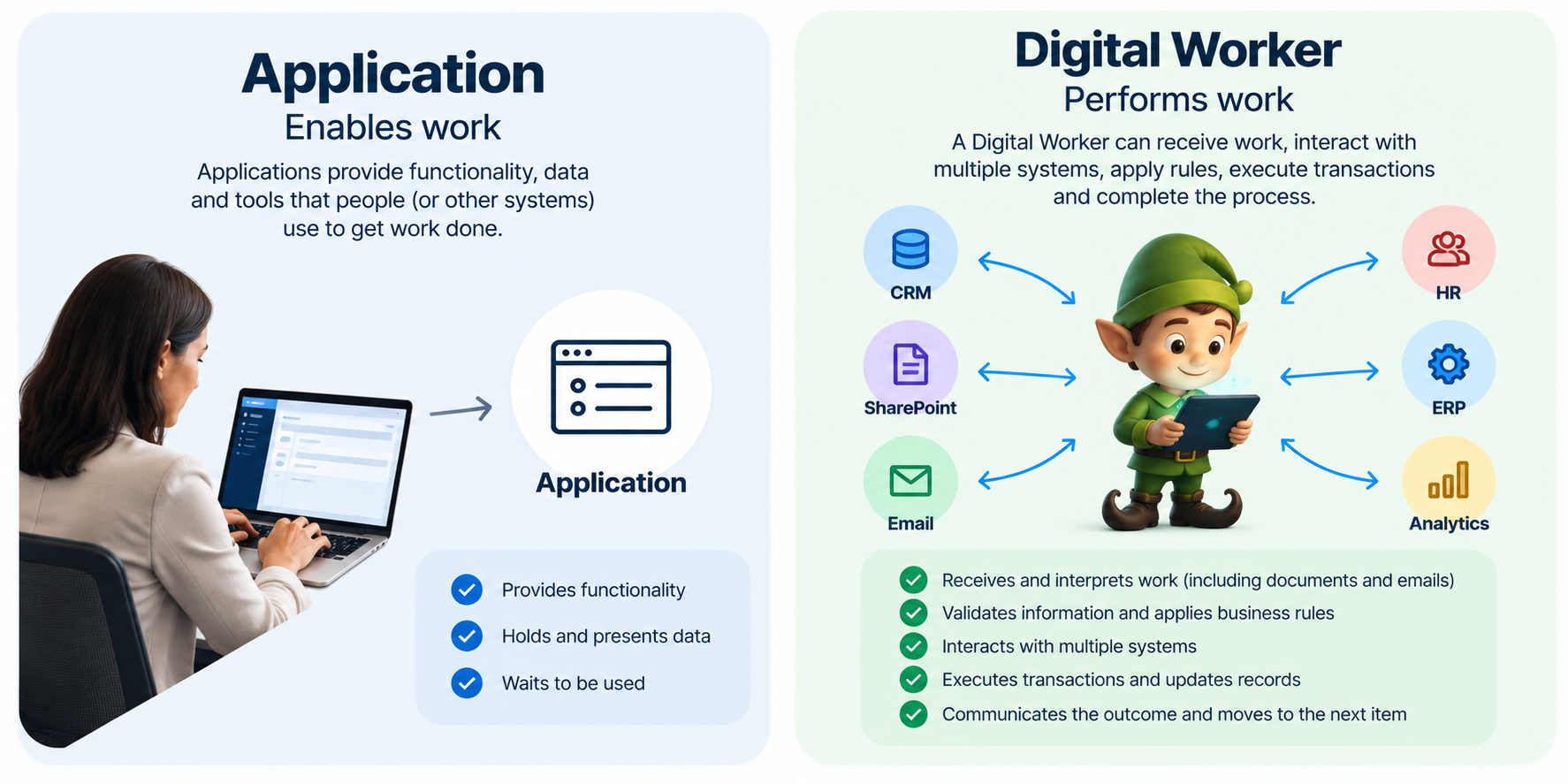
Most enterprise technology waits to be used.
A CRM holds information. An ERP processes transactions when instructed. A document management system stores content. A collaboration platform helps people work together.
A Digital Worker is different because it performs work.
It can receive something, validate it, apply rules, interact with multiple applications, execute a transaction, communicate an outcome and move on to the next item.
Add AI and that worker can potentially deal with information and circumstances that previously required considerably more human involvement.
This distinction matters.
If technology is performing work that would otherwise consume human capacity, management needs visibility over that work.
What is it doing? How much is it doing? Is it succeeding? What value is it creating? Where is it failing? What requires human intervention?
These are remarkably similar to the questions managers already ask about operational teams.
 The Digital Workforce doesn’t replace the human workforce. It changes its shape.
This is perhaps the most important management opportunity.
The objective shouldn’t be to ask:
“How many people can we replace with automation?”
A much more valuable question is:
“What work should we stop asking people to do?”
Consider the amount of organisational capacity consumed by activities such as moving information between systems, checking records, reconciling transactions, monitoring shared mailboxes, generating standard correspondence, updating spreadsheets, creating reports and following predictable workflows.
People can do these things.
That doesn’t mean they should.
When Digital Workers take responsibility for appropriate repetitive and rules-driven activity, people can spend more time on the things organisations actually employ them for: judgement, relationships, problem-solving, creativity, leadership and dealing with the unusual.
This creates an interesting management challenge.
The future workforce isn’t simply:
People + technology.
Increasingly it is:
People + Digital Workers + AI, designed around the work that needs to be done.
Now imagine…
| Imagine you were designing your organisation’s workforce today, from scratch.
You know the outcomes that need to be delivered. You have the people and expertise you need. But you also have Digital Workers available 24×7×365 to perform suitable repetitive and rules-based work, AI capable of interpreting information and supporting decisions, and people available for judgement, relationships and the work where human capability matters most. Would you allocate the work the same way you do today? Would people still move information between systems? Would experienced staff still monitor shared inboxes? Would teams still spend hours checking, reconciling and re-keying data? Would customers still wait while work moves manually between functions? Or would you design an entirely different workforce around the outcome? That is the opportunity. |
|---|
Someone still has to manage the work
There is sometimes an assumption that automation means removing management overhead.
In reality, successful automation changes what needs to be managed.
A Digital Workforce still needs clear ownership.
Processes need performance expectations. Exceptions need escalation paths. Business rules need owners. Changes to upstream and downstream systems need to be understood. Automation performance needs monitoring. AI decisions need appropriate controls. Benefits need to be measured.
And as the number of Digital Workers increases, coordination becomes increasingly important.
Imagine an organisation with 100 automated processes.
The question is no longer whether robot number 47 is technically running.
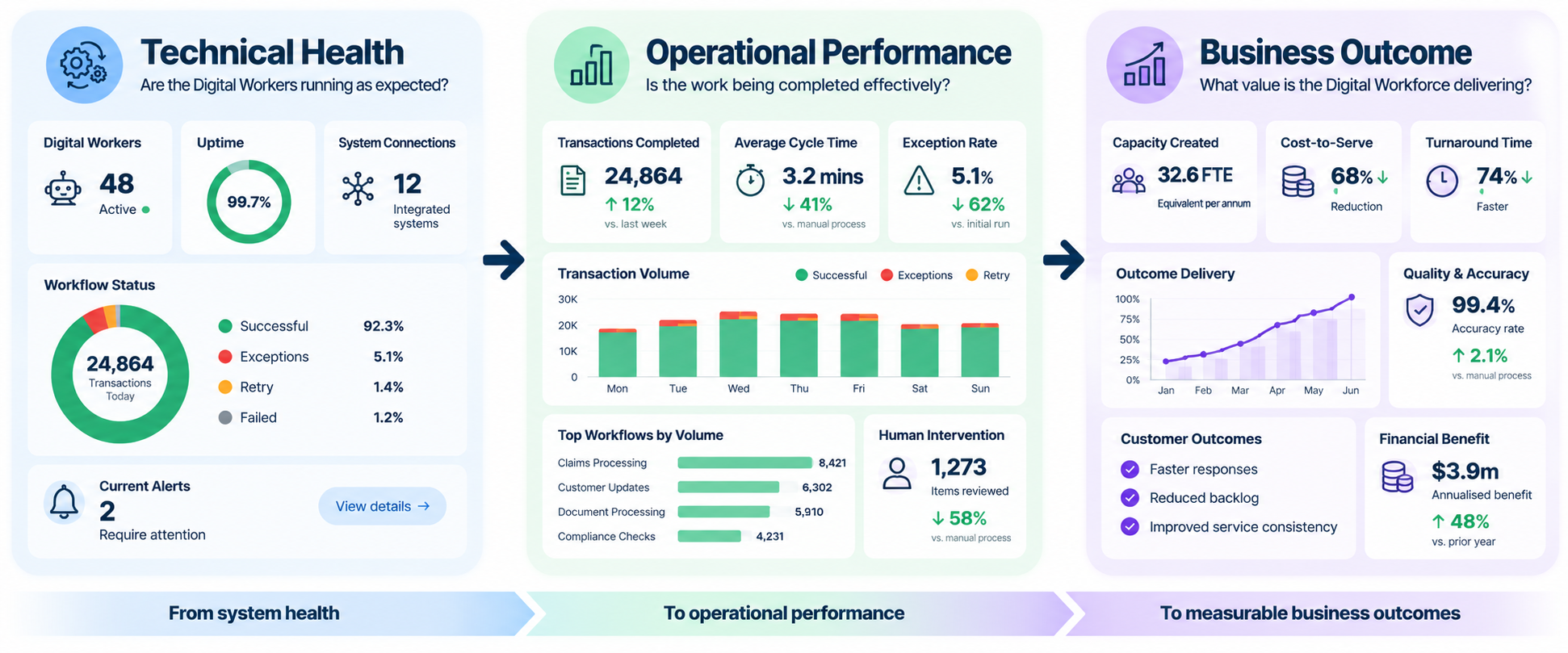
Management needs to understand:
What business outcome is the Digital Workforce delivering?
That means moving beyond technical measures such as uptime, transactions and exceptions to business measures such as capacity created, backlog removed, turnaround time, cost-to-serve, accuracy, customer outcomes and realised return on investment.
 This changes the role of IT too
For CIOs, this creates a particularly interesting opportunity.
The Digital Workforce shouldn’t become another collection of technology assets that IT is expected to own simply because software is involved.
The business owns the outcome.
Operations understands the work. Finance understands the economics. Risk understands the controls. HR understands the workforce implications. IT provides the architecture, integration, security and platforms that allow the capability to operate safely.
That requires partnership.
And it potentially elevates IT’s contribution considerably.
Rather than being asked to implement another tool, the CIO and technology function can help the organisation answer a much more strategic question:
How do we give the business access to automation and AI capabilities that allow it to operate differently, while maintaining the integration, security and governance the organisation requires?
That’s business enablement, not simply technology delivery.
Management also needs to know when not to automate
A mature Digital Workforce strategy isn’t measured by how many processes have been automated.
Some processes shouldn’t exist.
Some should be simplified.
Some should be redesigned.
Some need better data or knowledge before automation makes sense.
Some require human judgement.
And some are excellent candidates for end-to-end digital execution.
This is why starting with the technology can be dangerous.
If the question is:
“Where can we deploy automation?”
the organisation will find automation opportunities.
If the question becomes:
“How should this work be performed?”
the organisation can find a better operating model.
That distinction is at the heart of Design First, Automate Second.
From individual automations to a managed capability
The organisations that extract the greatest value from automation and AI are unlikely to be those with the most robots or the largest collection of AI tools.
They will be those that learn how to manage digital capacity as an organisational capability.
That means knowing what work exists, understanding where human effort is being consumed, identifying where Digital Workers can create capacity, governing how automation and AI operate, and continuously measuring whether the expected outcomes are being realised.
It also means having a pipeline.
As one Digital Worker releases capacity or eliminates a bottleneck, management should be able to see the next opportunity.
Over time, automation stops being a sequence of projects.
It becomes part of how the organisation manages work.
The executive conversation is changing
For the COO, the Digital Workforce becomes another lever for managing capacity, service levels, throughput and operational resilience.
For the CFO, it creates an opportunity to change the economics of work while making the benefits visible and measurable.
For the CIO, it provides a platform for enabling the business to operate differently, integrating existing technology investments rather than continually replacing them.
For business leaders, it provides the opportunity to remove administrative work from teams and redirect scarce human capability toward better outcomes.
And collectively, it introduces a question that belongs at the management table:
If we can choose whether work is performed by a person, automation, AI, or some combination of all three, how should we design our workforce?
That is a fundamentally different conversation from choosing an automation platform.
Where to start
Don’t start by trying to design a hundred-worker Digital Workforce.
Start with the work.
Take one meaningful operational process and understand the outcome it exists to deliver.
Identify where people spend their time, where work waits, where information crosses systems, where rules are applied, where judgement is genuinely required and where exceptions occur.
Then redesign the process around the capabilities now available.
- People for judgement.
- AI for intelligence.
- Automation for execution.
- Management for outcomes.
Do that repeatedly and something important happens.
You aren’t simply automating more processes.
You’re redesigning how the organisation gets work done.
And that’s why the Digital Workforce is becoming a management question, not a technology question.
Ready to see what your workforce could look like differently?
BBBD’s 3-Day Process Design Sprint starts with the work and the business outcome, then determines where people, automation and AI can create a better operating model.
The objective isn’t to find somewhere to deploy technology.
It’s to identify a measurable opportunity to improve how your organisation performs.
| Start with a Process Design Sprint | Design First, Automate Second |