
Organisations are investing heavily in AI. But intelligence without the ability to act often leaves value trapped between insight and execution.
AI has moved remarkably quickly from experimentation to executive priority.
Organisations are deploying copilots, testing agents, introducing generative AI, improving search and exploring how AI can help people make faster, better-informed decisions.
There is enormous potential in all of this.
But there is also a gap emerging in many AI strategies.
AI can understand, analyse, predict, summarise and recommend. That doesn’t necessarily mean it can get the work done.
A model might identify an issue. A copilot might draft the response. An agent might determine what should happen next.
But if someone still has to open another application, find the customer record, validate the information, enter the transaction, update three systems, send the notification and record the outcome, the organisation has improved the intelligence around the process without fundamentally changing the process itself.
That is the automation gap.
 What we’re seeing
The current enthusiasm for AI is understandable. Its capabilities are immediately visible.
Ask an AI system to analyse a document, summarise a meeting or draft a response and the result appears in seconds.
Automation is less spectacular to watch.
It operates behind the scenes: moving information, validating data, applying business rules, updating systems, triggering workflows, reconciling transactions and ensuring work actually reaches completion.
Yet that execution layer can determine whether AI produces an interesting demonstration or a measurable business outcome.
Consider a relatively simple operational scenario.
AI receives an incoming request and can:
- understand what the customer is asking
- classify the request
- extract the relevant information
- assess the context
- recommend the appropriate action.
That’s valuable.
But the organisation only captures the full value when the next steps can also happen:
validate the customer → check the relevant systems → apply the business rules → create or update the transaction → route exceptions → communicate the result → record what happened.
That is where AI and automation become considerably more powerful together.
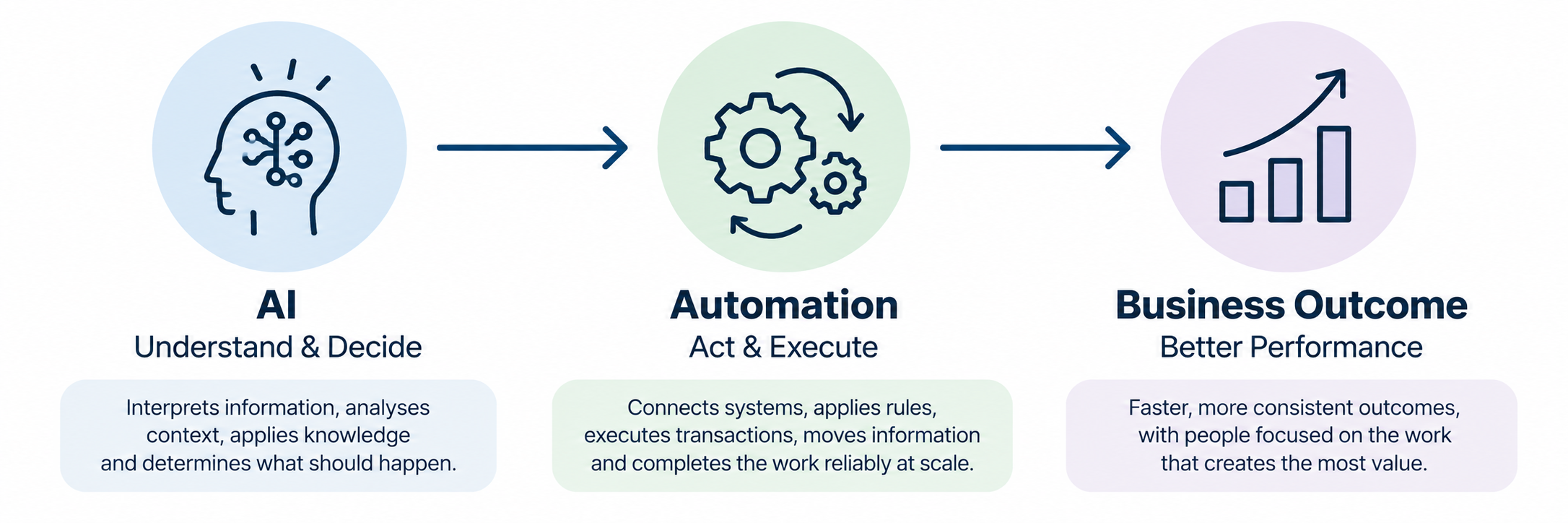
AI can think. Automation can act.
We see AI and automation as complementary capabilities rather than competing technologies.
AI adds intelligence to the process.
It can interpret unstructured information, understand language, recognise patterns, summarise complex material and support decisions that conventional rules-based automation cannot easily make.
Automation gives that intelligence the ability to operate.
It connects systems, executes transactions, moves information, applies deterministic rules, manages workflow and performs repetitive work reliably at scale.
Put them together and something much more interesting becomes possible:
AI determines what needs to happen. Automation makes it happen.
And importantly, people remain involved where judgement, accountability, empathy or exception handling requires them.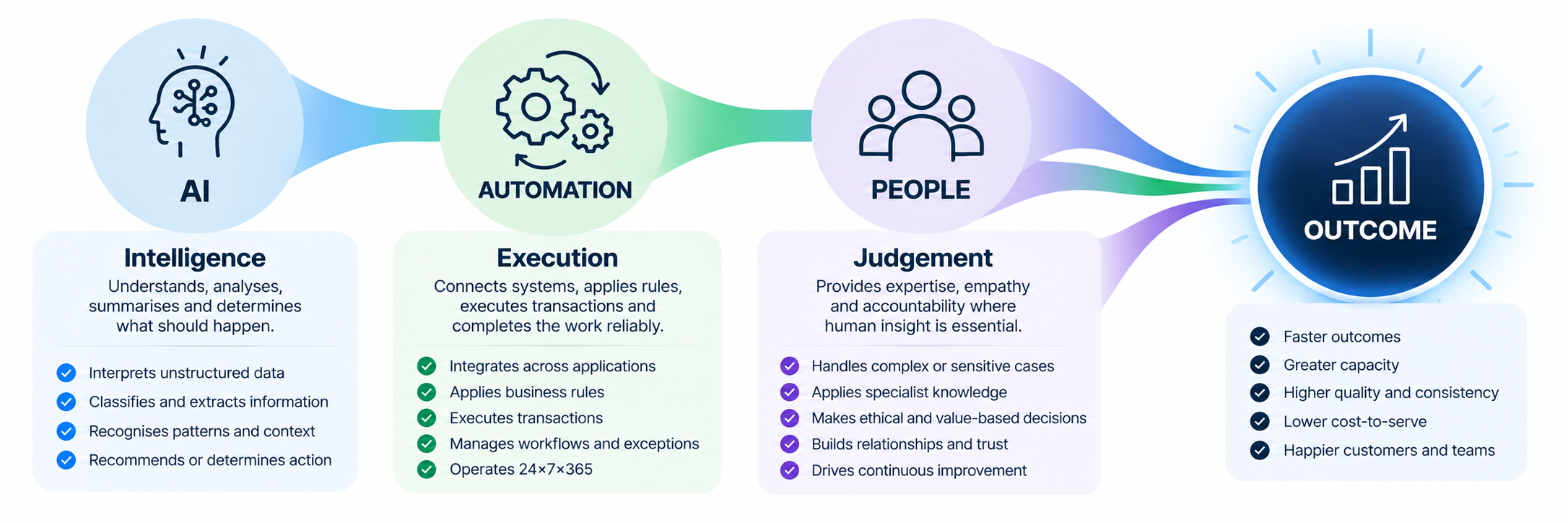
The opportunity isn’t simply to add AI to today’s processes
This is where we think organisations need to be particularly careful.
Take an existing process with unnecessary hand-offs, duplicated data entry, disconnected systems and cumbersome approvals, then put AI over the top of it, and you may simply create a more intelligent version of an inefficient process.
The better question is:
If we had today’s automation and AI capabilities when we originally designed this process, would we have designed it this way at all?
Frequently, the answer is no.
That is why our principle remains:
Design First. Automate Second.
Start with the outcome.
Determine what work actually needs to happen, what can be eliminated, what should be automated, where AI genuinely adds intelligence, where deterministic rules provide greater certainty and where people create the most value.
Then design the combination around that.
- The objective isn’t more AI.
- It isn’t more automation either.
- It is a better-performing organisation.
Look beyond the copilot
There is another important distinction for executives.
Much of the first wave of enterprise AI has concentrated on making individuals more productive.
Draft this email. Summarise this document. Analyse this spreadsheet. Find this information.
Those capabilities can be extremely useful, but they largely improve the productivity of the person performing the process.
The next opportunity is bigger:
What if we improve the process itself?
Instead of helping someone manually process 100 requests more quickly, could AI interpret those requests while automation completes the deterministic work, leaving people to handle only the cases that genuinely require their expertise?
Instead of helping someone find information across multiple systems, could the digital workforce retrieve, validate and assemble it automatically?
Instead of producing another AI-generated recommendation for someone to action, could an appropriately governed workflow safely execute the approved action?
This shifts the conversation from personal productivity to organisational capacity.
And that is where the economics can become much more interesting.
The automation gap matters to different executives for different reasons
For a CFO, closing the gap creates a clearer path from AI investment to measurable economic outcomes: lower cost-to-serve, increased capacity, improved control and an evidence base for whether the investment is actually delivering.
For a COO, it creates the opportunity to redesign work rather than simply accelerate individual tasks. Processes can operate more consistently, backlogs can be attacked systematically and people can concentrate on exceptions, customers and higher-value activity.
For a CIO, this is an opportunity to turn AI from another technology being introduced into the organisation into a capability the business can actually use. Connecting AI safely to processes, systems, data and governed automation allows IT to enable new ways of working without surrendering the controls required to operate responsibly.
The technology matters.
But the outcome matters more.
| Start with a Process Design Sprint | Design First, Automate Second |