
Automation and AI are creating an extraordinary opportunity for CIOs: not simply to introduce the next generation of technology, but to change what the organisation itself is capable of doing.
CIOs have spent years building increasingly sophisticated technology environments. Cloud platforms, ERP, CRM, collaboration tools, data platforms, cybersecurity, integration, digital channels and SaaS have transformed the technology available to the organisation.
And yet walk into almost any business and you will still find highly capable people copying information between systems, monitoring shared mailboxes, checking spreadsheets, reconciling data, chasing approvals and navigating cumbersome processes to get relatively straightforward work completed.
That isn’t necessarily evidence of a technology problem. In many cases, the applications are doing exactly what they were designed to do. The opportunity now is to make them work together to achieve more.
Automation and AI give the CIO an exciting new lever. Instead of asking “What technology does the business need next?”, the conversation can become:
“What new capability could we give the business using the technology we already have?”
That’s a much bigger question. And it puts the CIO in an extraordinarily powerful position.
The next technology breakthrough may not be another technology
Most organisations have already made significant investments in their core platforms. The challenge is that business processes rarely live neatly inside one of them.
A customer request might arrive through email or a contact centre, require information from a CRM, trigger a check against another application, require a transaction in an ERP, generate correspondence and ultimately need to be recorded somewhere else. Today, people often provide the integration. They move between applications, interpret information and make the process work.
Automation changes that. A Digital Worker can operate across the existing environment, connecting systems at the process level and completing work that previously required people to navigate between them. AI extends the opportunity further by allowing the process to understand documents, language, context and increasingly complex information.
Suddenly the CIO has another option. It isn’t necessarily replace the system. It can be make the existing environment capable of doing more.
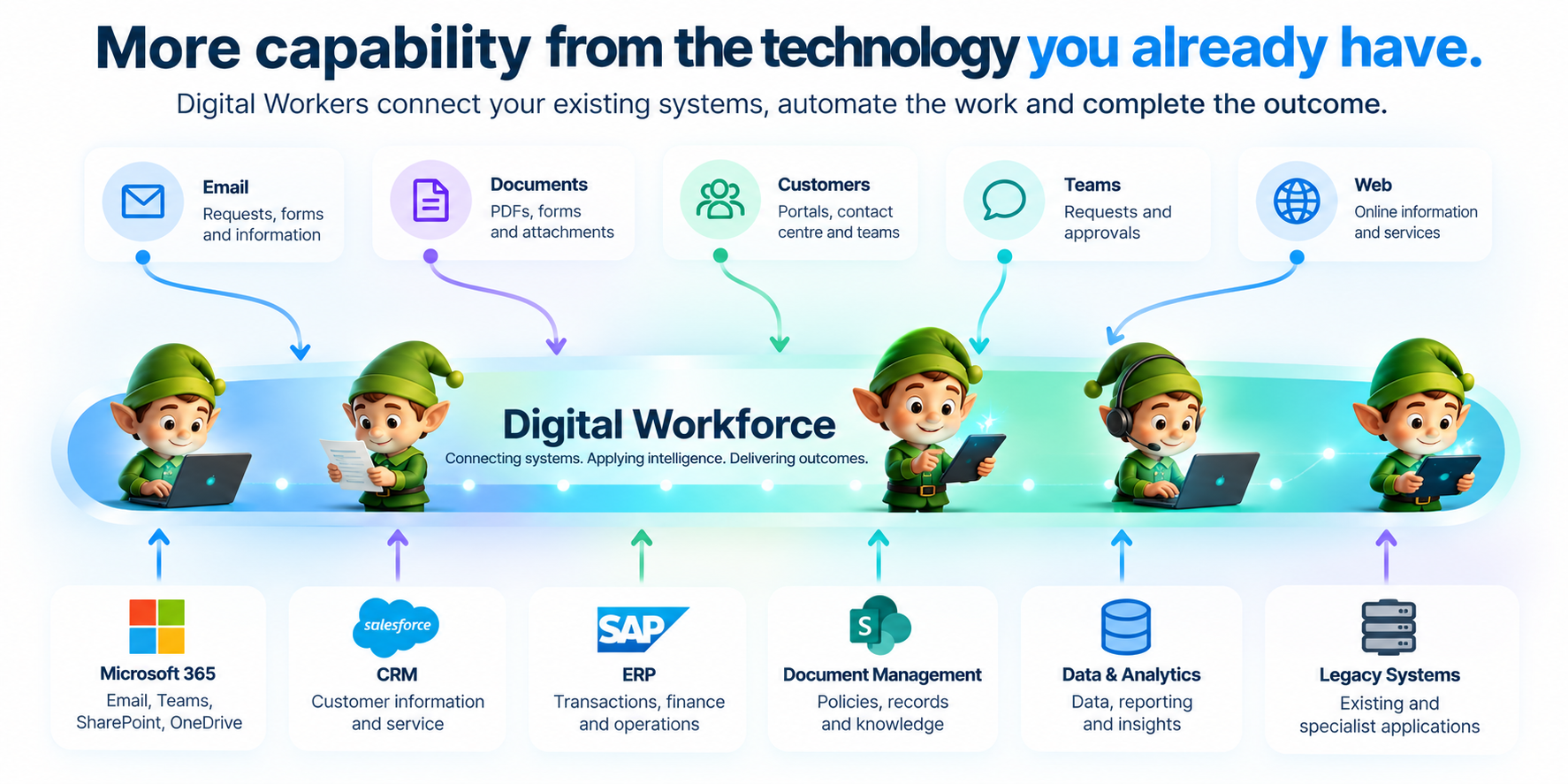
This is where the CIO gets to become an enabler of possibility
The CIO has traditionally carried some difficult responsibilities: keeping the lights on, protecting the organisation, maintaining architecture, managing vendors and technical debt, integrating platforms and delivering major programmes. All are essential, but they don’t always allow the CIO to demonstrate the full strategic value technology leadership can bring to the organisation.
Automation and AI create a different conversation.
When a business leader says, “We can’t keep up with the workload,” the CIO can help create capacity. When Finance says, “We’re spending too much time reconciling this manually,” the CIO can help redesign it. When Operations says, “Our people have to use four different systems to complete this process,” the CIO can connect the work across them. When Customer Services says people spend too much time finding information rather than helping customers, the CIO can help bring information, automation and AI together.
And when the executive team needs to take cost out without damaging service, the CIO can bring forward measurable opportunities to change how work gets done.
That’s a very different relationship with the business.
Technology stops being something the CIO supplies and becomes capability the CIO enables.
From gatekeeper to capability multiplier
Governance isn’t going away, nor should it. AI and automation increase the importance of cybersecurity, architecture, data protection, privacy, identity, resilience and appropriate controls. But good governance doesn’t have to mean standing between the business and innovation.
The opportunity is to create a governed environment in which the business can do more.
Instead of IT being perceived as the function that says “You can’t do that because…”, the CIO can increasingly say “Yes. And here’s how we can do it safely.”
The technology function retains the guardrails, architecture and enterprise oversight the organisation needs, while giving business teams access to capabilities that allow them to improve their own operations. Governance becomes an accelerator rather than a brake.
This is potentially one of the biggest changes automation and AI can bring to the relationship between IT and the wider organisation.
The CIO doesn’t have to own every process to transform it
The CIO doesn’t need to become the COO, and technology doesn’t need to take ownership of Finance, HR, Customer Services or operational processes. The business should continue to own its outcomes, rules and priorities.
But the CIO can provide something those functions cannot easily create independently: a common capability for connecting systems, applying automation, safely introducing AI and governing how those technologies operate across the enterprise.
That changes the relationship. The business brings the problem and owns the outcome. IT brings the capability, architecture and guardrails. Together, they redesign how the outcome is delivered.
That is far more powerful than another queue of technology requests.
Now imagine…
| Imagine your next executive meeting.
The conversation turns to operational pressure. One executive has a growing backlog. Another needs to reduce cost. A third can’t recruit enough people. Someone else is frustrated by an important process that takes days because work keeps moving between teams and systems. Instead of taking away another list of technology requirements, imagine being able to say: “Before we invest in anything new, let’s look at the work. There may be a way to use automation and AI across the systems we already have to remove the bottleneck entirely.” Then imagine returning with the redesigned process, the capacity it could create, the systems it would connect, the controls it would maintain, the investment required and the measurable return the organisation could expect. That’s not simply supporting the business with technology. That’s helping lead the business. |
|---|
AI makes this opportunity considerably bigger
Automation has already demonstrated that software can perform structured, repeatable work across systems. AI expands the boundary of what is possible because processes that were previously difficult to automate due to documents, language, interpretation or large amounts of unstructured information can increasingly be redesigned.
AI can understand. Automation can execute. Existing enterprise systems can continue to provide the underlying systems of record. People can concentrate on judgement, relationships, exceptions and higher-value activity.
And the CIO is sitting at the intersection of all four.
That is why the emergence of AI should strengthen the strategic role of the CIO. Someone needs to understand how these capabilities fit together, connect them safely to the enterprise and ensure innovation doesn’t create another generation of disconnected technology.
Someone needs to turn technical possibility into organisational capability.
That is a natural leadership opportunity for the CIO.
Don’t give the business another AI tool. Give it an AI capability.
There is a significant difference.
Another AI tool adds another technology to the estate. An AI capability gives the organisation a repeatable way to apply intelligence where it improves an outcome. The same applies to automation: one robot solves one problem, while a Digital Workforce capability creates a way for the organisation to continually identify, prioritise and automate suitable work.
This is where CIO leadership becomes particularly important. Rather than allowing automation and AI to proliferate as isolated initiatives, the CIO can establish the foundations that allow them to scale: integration, security, identity, validated knowledge, governance, orchestration, monitoring and common design principles.
Individual business initiatives can then build on those foundations instead of reinventing them.
The result isn’t simply more technology.
It’s a more capable organisation.
And it changes the economics of IT
Technology strategies have traditionally created value partly through major programmes: new platforms, migrations, consolidation and replacement. Those programmes will continue to be necessary, but automation creates another route to value.
It can allow organisations to extract more from investments they have already made.
If an organisation can connect an existing ERP, CRM, document repository and communications platform through automation rather than replacing them simply to resolve process friction, the economics can be compelling.
The CIO can therefore become an active contributor to productivity and cost reduction, not merely the person being asked to reduce the IT budget.
Instead of the executive conversation being “How much can we take out of technology?”, it can become:
“How much value can technology help us take out of the cost of operating the organisation?”
That’s a much more interesting conversation for a CIO to lead.
Success should be measured in business language
This opportunity also changes how the CIO can demonstrate success.
Instead of reporting “We deployed 20 automations,” report the capacity those automations created. Instead of “We implemented an AI solution,” show the reduction in turnaround time. Instead of “We integrated four systems,” demonstrate the manual steps that disappeared. Instead of celebrating the number of transactions processed, show how cost-to-serve, service levels or customer outcomes changed.
These are measures the entire executive team understands.
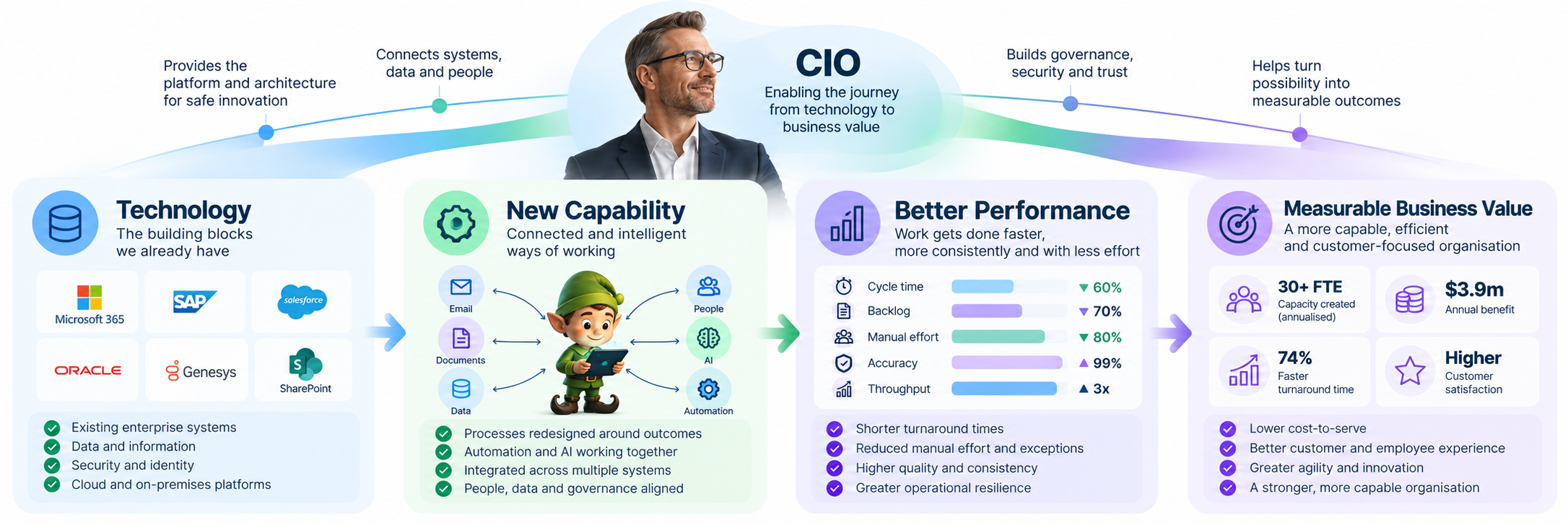
And importantly, the conversation stops being about what IT delivered and starts being about what the organisation can now achieve because IT enabled it.
This isn’t about making IT bigger
Quite the opposite. It’s about making IT more influential because the capabilities it enables become more valuable.
The best outcome isn’t a huge central automation team controlling every workflow. It’s an organisation in which business teams increasingly understand what can be automated, identify their own opportunities and work within an enterprise framework established with IT.
As maturity increases, ownership can move closer to the business. IT provides the platform, integration, architecture, governance and expertise, while the business increasingly owns the improvement and the outcome.
That creates scale without creating another bottleneck.
And it puts the CIO exactly where a strategic technology leader should be:
enabling the organisation to achieve things it couldn’t achieve before.
The opportunity may already be inside the organisation
There will always be another platform to buy, another application to implement and another technology trend to evaluate. But some of the biggest opportunities available to CIOs today may already be sitting inside their organisations.
They’re hidden in the gaps between existing systems, the manual workarounds, spreadsheets and shared mailboxes. They’re in the repetitive work performed by expensive people, processes that have accumulated complexity over years, and applications that work perfectly well individually but don’t complete the business outcome together.
Automation and AI give CIOs an opportunity to go after those gaps, not with technology for technology’s sake, but by giving the organisation new capability.
Every time that capability creates capacity, reduces cost, removes a bottleneck, improves a customer experience or gives people back time for more valuable work, the organisation gets to see something important:
what a strategically enabled technology function can really contribute.
Where to start
Pick a business problem, not a technology. Ideally, pick one that matters to another executive: a Finance problem, an Operations problem, a Customer problem or a People problem.
Understand the outcome they need and the work currently standing in the way. Then bring together the business owner, process expertise and technology capability and ask:
“If we designed this today, with automation and AI available to us, how would we do it differently?”
Make the first result measurable. Create capacity, reduce turnaround time, remove cost, improve quality or eliminate a backlog. Then show the organisation what happened.
Because the strongest argument for the next opportunity isn’t another presentation about AI.
It’s a business leader telling their peers what the CIO just helped them achieve.
Give the business something it couldn’t do yesterday
BBBD’s 3-Day Process Design Sprint starts with a real business outcome and identifies how process redesign, automation and AI can create new organisational capability using the systems you already have.
It gives the CIO something particularly valuable: a practical, measurable opportunity to take back to the business.
| Start with a Process Design Sprint | Design First, Automate Second |